
An article written by Jacques Mc Neill, advisor to our Kirq project
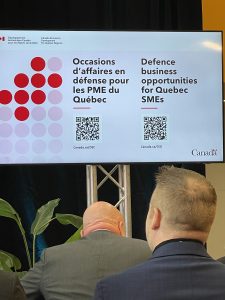
Over the past few months, I’ve noticed a growing interest in cybersecurity and in the purpose of quantum communications, fueled in particular by several defence-related announcements from the Government of Canada. On February 20, nearly 300 people attended the event “Defence: Seizing Opportunities in a Strategic Market” organized by Développement Économique Longueuil (DEL), and just as many were unable to attend. Several federal and provincial politicians were present, adding to the energizing buzz.
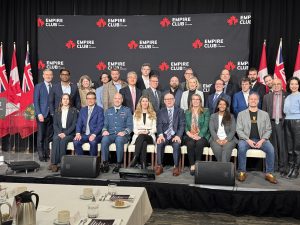
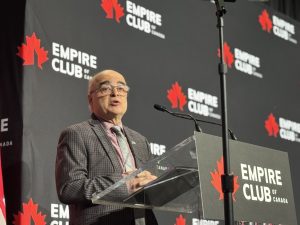
On February 24, I had the honour of speaking at a major conference organized by the Empire Club of Canada and Quantum Industry Canada (QIC) on a global strategic issue: “Quantum Power and National Security: Canada’s New Strategic Imperative.” Lisa Lambert, CEO of QIC, examined how quantum capabilities will influence Canada’s economic outlook and security posture, what sovereign capacity is needed to protect critical systems, and how Canada can position itself as a strategic contributor within G7 and NATO alliances.
In the closing remarks, Mr. Jeffrey Maddox, President of Nokia Canada, and I announced the success of Blueprint 7. Collaborative tests on the Kirq testbed in Montréal carried out by Nokia, Crypto4A, evolutionQ and NowQuantum demonstrated that it is possible to transmit data protected by unbreakable keys, even against quantum computers, over existing fibre-optic networks. Quantum computers are vastly more powerful than today’s computers.
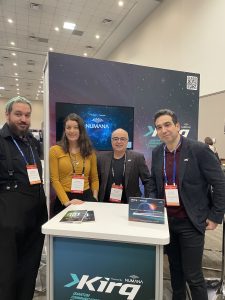
The next day, February 25, at the Federal Government Cybersecurity Conference in Ottawa, my colleagues Philippe Barraud and Florian Saugues led and participated in various workshops, while Amélie Roy-Fortin and I were at the Kirq booth to inform roughly 900 attendees about how Kirq can help them develop a quantum-resilient cybersecurity roadmap and test solutions in real-world conditions on off-network telecommunications infrastructure.
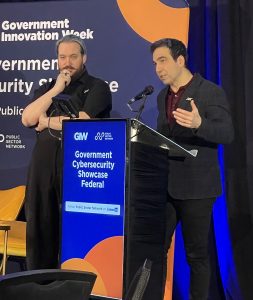
I believe it is highly significant to be having these conversations now, at a time when Canada’s strategic choices are crucial. I want to protect not only my medical record and my bank account, but our entire digital infrastructure. It is national infrastructure that safeguards banking payment systems, patient data, energy networks and telecommunications networks. Digital infrastructure protects our sovereignty.
What particularly impressed me was the profile of the 400 people present at the Empire Club. Numana is raising awareness of the importance of quantum technologies. In fact, I believe it was one of the first conferences I attended where it wasn’t only the usual representatives of the quantum ecosystem, but also people from Bay Street and the more conventional economy who came to a conference focused specifically on quantum.
Even though the quantum sector is complex, our message is simple, and it’s starting to land. We bring experts together to design Canadian, sovereign quantum security solutions. And they are now available. The Kirq testbed shows that the transition can happen without disrupting existing network infrastructure. But we need to move quickly: organizations that act early manage this change on their own terms and write the playbooks that will guide the nation.
Kirq is an open, collaborative testbed: come and take advantage of it. I invite you to meet with us, share your challenges, and potentially take part in other tests that Numana and its partners will be conducting this year on Kirq, deployed in Montréal, Quebec City and Sherbrooke.
To watch the panel: Quantum Power and National Security: Canada’s new strategic imperative – Empire Club of Canada
To read an article on Blueprint 7: Québec breakthrough in quantum-secure transmissions – Les Affaires


